A butterfly valve or a ball valve opens and closes. In many processes, however, that is not enough: steam, hot water or aggressive media have to be dosed, controlled and brought to set points. This is exactly what seat valves are made for. They control flow, pressure and temperature precisely and shut off reliably.
As a trading partner of Schubert & Salzer Control Systems, Armaturenfabrik supplies angle seat and globe valves in stainless steel. We help you select them, modify them on request and install them in our plants. This article shows how the two designs differ, which types are available and what to consider when installing them in SKID and process plants.

Angle seat valve:
high flow at low resistance
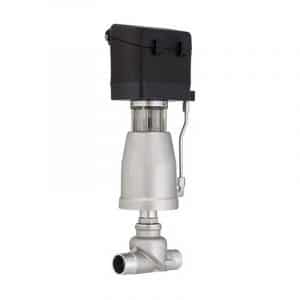
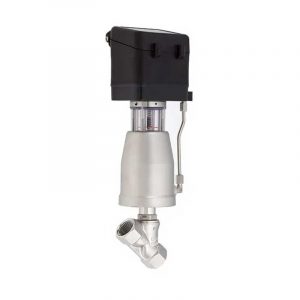
In an angle seat valve, the valve seat is set at an angle to the direction of flow. The medium is therefore deflected less, flow resistance drops, and the result is high Kvs values with energy-efficient control. Angle seat valves are the preferred solution for high temperatures and aggressive media.
Typical features:
- High Kvs values for optimum flow capacity
- Compact design for space-saving installation
- Insensitive to vibration and can be installed in any position
- TA Luft tested, leakage class VI to IEC 60534-4
Two types in our range:
Globe valve:
linear flow, high control accuracy
The globe valve guides the medium through the valve in a straight line. It offers high control accuracy, a compact design and is easy to insulate. It suits neutral as well as aggressive media, including at high temperatures and pressures.
Two types in our range:
- Type 7017, pneumatically operated, with high Kvs values and a compact design
- Type 7027 with integrated positioner, also available with an Ex option
A manual override and special versions are available as options.
Angle seat or globe valve: the comparison
| Criterion | Angle seat valve (7010 / 7020) | Globe valve (7017 / 7027) |
| Nominal size | DN 8 – DN 80 | DN 15 – DN 50 |
| Pressure rating | PN 40 | PN 40 |
| Temperature | -30 °C to +220 °C | -30 °C to +220 °C |
| Material | Stainless steel 1.4408 | Stainless steel 1.4408 |
| Seal | PTFE | PTFE, PEEK |
| Flow path | Angled seat, low flow resistance | Linear flow path |
| Strength | High Kvs values, high temperatures, aggressive media | High control accuracy, easy to insulate |
| With positioner | Type 7020 | Type 7027 (Ex option) |
In practice, the task decides. Where high flow at low pressure loss is needed, there is much to be said for the angle seat valve. Where control accuracy comes first or the valve needs to be well insulated, the globe valve is often the better choice.
Positioners and automation
An actuator and a positioner turn a seat valve into a control valve. Available options are the i/p positioner type 8047 and the digital positioner type 8049. For hazardous areas, an electro-pneumatic positioner in Ex design (ATEX, IECEx) is also available. Types 7020 and 7027 already come with an integrated positioner.
How actuators, limit switches and solenoid valves become one tested unit is explained in our article on valve automation.
Connections and standards
- Butt-weld ends to ISO 1127
- NPT thread
- Special connections on request
- Design to Pressure Equipment Directive 2014/68/EU, TA Luft tested, leakage class VI to IEC 60534-4
From valve to plant: installation in SKID and process modules
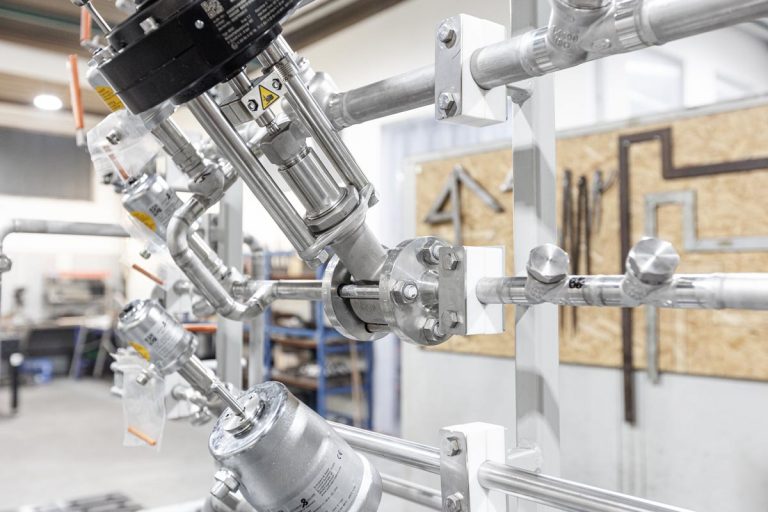
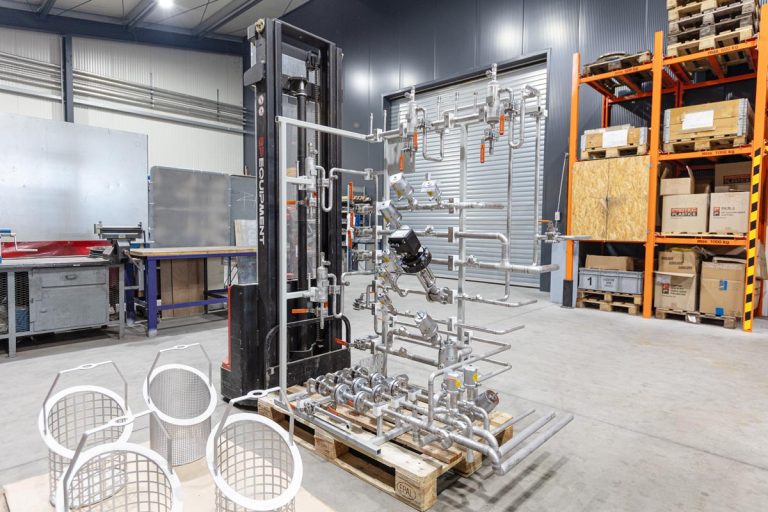
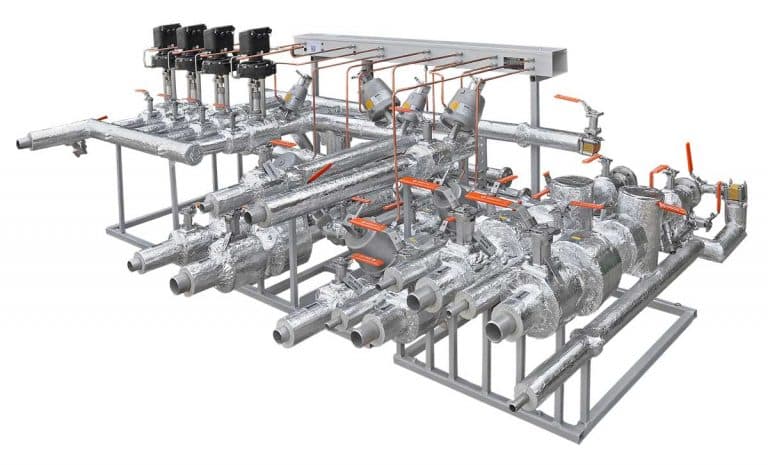
Seat valves are key components in modular SKID systems, for example in steam packages, valve stands and dosing lines. Their compact design allows integration into prefabricated modules, and they can be automated with pneumatic or electric actuators.
In the works of Industriefabrik Schneider GmbH, the valve becomes part of a complete system:
- Installation in the pipeline: valves with weld ends are welded into the prefabricated pipeline, threaded versions are screwed in.
- Mounting on the SKID frame with pipe routing and supports.
- Pneumatic and control connection: hoses or tubing, pressure regulators, solenoid valves.
- Insulation with our in-house system (IFS-PLAST25 / IFS-MW20) for temperature-critical media.
- Function test before delivery.
Sizing the valves correctly in the plant from the start is crucial. A fully piped SKID can hardly be corrected on site.
Typical industries
- Chemicals and petrochemicals: control of aggressive media, acids and alkalis
- Energy and power plants: steam, water and cooling circuits at high pressure and high temperature
- Food and beverages: hygienic versions for CIP/SIP processes
- Pharma and biotechnology: sterile control without dead space
- Water and wastewater: treatment, desalination, cooling water systems
- Oil, gas and mechanical engineering: SKID process modules, refineries, offshore applications
Conclusion
With PN 40, temperatures from -30 °C to +220 °C and nominal sizes from DN 8 to DN 80, angle seat and globe valves from Schubert & Salzer cover a wide range of process control. Armaturenfabrik advises on the selection and integrates the right actuator and positioner. We install the valves in pipelines and SKID modules of Industriefabrik Schneider GmbH, tested and ready for installation.
Products from the valves category
Make a request directly
Would you like individual advice?