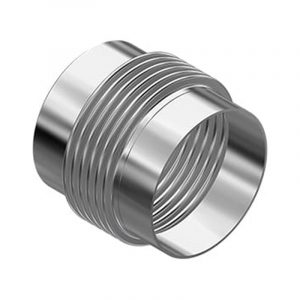
The Willbrandt range at Armaturenfabrik
We trade in Willbrandt expansion joints and supply directly from the manufacturer range. The overview below shows four series that we supply regularly and recommend for the respective application – they are a selection, not a limit. We can source the complete Willbrandt range, including series not listed here. Which series fits is decided in this order: first the type of movement, then the medium, then the connection.
| Series | Movement | Bellows | Connection | Pressure rating | Nominal sizes |
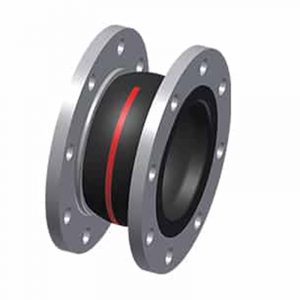
| Rubber expansion joint type 50 | multi-axial, at the same time vibration and noise decoupling | highly elastic rubber bellows with reinforcing plies and integrally moulded sealing bead | swivel flanges on both sides in electrogalvanised steel, drilled to DIN PN 10 | PN 10 standard, orange version up to 25 bar | DN 20 – DN 1000 |
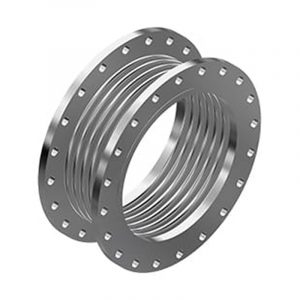
| Axial expansion joint type 206 / 210 | axial | stainless steel 1.4541, type 206 single-ply, type 210 multi-ply | weld ends in carbon steel, bevelled ready for installation (type 210 from 3.5 mm wall thickness) | PN 2.5 and PN 16 | from DN 15 |
| Axial expansion joint type 208 / 212 | axial, type 212 additionally lateral and angular | stainless steel 1.4541, type 208 single-ply, type 212 multi-ply | rotatable backing flanges | PN 10 and PN 16 | DN 15 – DN 250 |
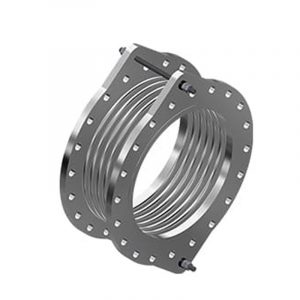
| Lateral expansion joint type 222 / 223 | lateral only, in all sideways directions | multi-ply corrugated bellows in stainless steel 1.4541 | backing flanges, tie-rod restraint welded on | PN 6, PN 10, PN 16, PN 25 – up to 25 bar g | from DN 50 |
The flat-corrugated type 50 reduces up to 70 % of the incoming energy and is therefore the choice when not only expansion but also structure-borne noise is to be decoupled. The tie rods on the type 222 absorb the reaction forces so that the internal pressure does not force the pipeline apart.
Choosing the elastomer: the colour coding of the type 50
With the rubber expansion joint, suitability is not decided by the frame size but by the elastomer material. Willbrandt identifies it by colour. The overview shows which version belongs to which medium:
| Version | Suitable for | Particular feature |
| Type 50 red | drinking water, hot, sea and cooling water with glycol or treatment additives, weak acids and alkalis, salt solutions, technical alcohols, esters, ketones | not for oil products or cooling water containing oil; surfaces dissipative |
| Type 50 black EPDM | as type 50 red | maximum operating pressure 10 bar |
| Type 50 red EPDM | as type 50 red, but not for drinking water, shipbuilding or offshore | maximum 90 °C at 10 bar |
| Type 50 black CR | cold, hot, swimming pool, salt and waste water, cooling water with glycol and oil-based corrosion inhibitors, oil mixtures, compressed air containing oil | surfaces insulating |
| Type 50 yellow | oils, lubricants, fuels, gases, town gas and natural gas, fuels with an aromatic content of up to 50 % | not for liquefied gas; surfaces conductive |
| Type 50 yellow LT | as type 50 yellow, additionally liquefied gas | dissipative inside, conductive outside |
| Type 50 yellow St | as type 50 yellow | flame-resistant for up to 30 minutes at 800 °C |
| Type 50 yellow HNBR | as type 50 yellow St | temperature range up to +100 °C |
| Type 50 orange | as type 50 yellow, additionally liquefied gas to DIN EN 589 | up to 25 bar operating pressure; surfaces conductive |
| Type 50 white | foodstuffs containing oil and fat, rubber in food grade | not approved for drinking water |
| Type 50 white SP | foodstuffs free of oil and fat, acids and alkalis, BfR- and FDA-compliant | for CIP cleaning up to 130 °C, briefly 150 °C |
With aggressive media we have the material resistance checked before sizing – this is the point at which ordering from a catalogue regularly goes wrong.
Vacuum operation and pressure ratings
On the rubber expansion joint, vacuum resistance depends on the nominal size: DN 20 to DN 50 are vacuum-tight, DN 65 to DN 250 withstand down to −200 mbar, and from DN 300 a vacuum support spiral is required. With a support spiral, all nominal sizes from DN 65 to DN 1000 are vacuum-tight. For the type 50 black EPDM version the following applies instead: DN 20 to DN 40 down to −300 mbar, from DN 50 only with a support spiral.
The burst pressure is above 48 bar for DN 20 to DN 400 and above 30 bar for DN 450 to DN 1000.
Among the metal expansion joints, types 206 and 208 are vacuum-tight in the standard version. The permissible operating data are DN 15 to DN 150 at 16 bar g and DN 200 to DN 250 at 10 bar g for the type 208, and DN 15 to DN 50 at 16 bar g for the type 206. If the lateral expansion joint type 222 is operated under vacuum, an internal tie restraint is added.
Optional: adaptations to Willbrandt expansion joints
As a rule we supply the Willbrandt series version. Because face-to-face length and installation situation are predetermined with expansion joints, however, adaptations are requested more often here than with other valves – as a supplement to the trade, not as a precondition:
- Face-to-face length made to measure – on the type 222 also differing from the standard lengths, for long lengths with a welded-in intermediate pipe
- Inner liner tube (type 223) for flow-critical and abrasive media, outer protective tube for mechanically loaded installation locations
- Special flanges – the standard drilling is DIN PN 10; other materials and dimensions are possible
- Restraints and vacuum support spirals where internal pressure or vacuum require them
- Baffles, PTFE lining and equipotential bonding
- Protective covers – flame-resistant, dust- and splash-proof, as soil cover or sun protection
- Installation into complete assemblies with valve, actuator, limit switch and documentation, delivered ready for installation
Notes for planning and installation
Two points are regularly overlooked in practice and lead to premature failure: the rubber bellows must not be painted, and at medium temperatures above 50 °C it must not be insulated over – the resulting heat build-up damages the elastomer. Where insulation is unavoidable, we will select a metal version or a different installation solution with you.