The most dangerous moment in the life of a pipeline is not continuous operation — it is the first commissioning. Weld spatter, scale, gasket residue and metal shavings that found their way into the line during construction come loose when the medium first flows through and travel straight towards the most expensive and most sensitive parts of the plant: pumps, valves, instruments and heat exchangers.
Conical strainers and plug-in screens exist for precisely this critical moment — temporary filter solutions that are installed between standard flanges and protect the plant during the start-up phase. This article explains how both types of screen work, how they differ and when each is the right choice.
Why the start-up phase needs special protection
With every new pipeline installation — and equally after major maintenance work — residues remain in the system that do not belong there:
- Weld spatter and scale from weld seams
- Mill scale residue from pipe manufacture
- Gasket residue from flange connections
- Grease and assembly residues
Without a protective measure, these particles pass straight into downstream plant components when the system is first started up — butterfly valves, ball valves, pump impellers or sensitive instruments. The result can be damage that costs far more than the filter protection itself. Conical strainers and plug-in screens are therefore installed between standard flanges to DIN EN 1092-1 (form B1) or ANSI B16.5 and catch these contaminants before they can do any harm.


Conical strainer —
the classic choice for start-up protection and continuous operation
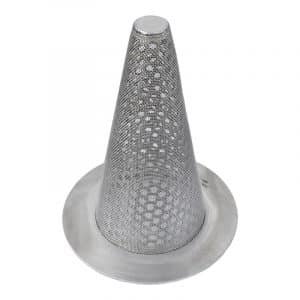
The conical strainer (type H), also known as a cone or hat-type screen because of its characteristic conical shape, is the most frequently used solution for temporary start-up protection. A perforated stainless steel cone is clamped between two flanges and, by virtue of its shape, offers a comparatively large filter area.
Key data:
- Nominal sizes from DN 20/50 to DN 500/600 (depending on the design)
- Pressure ratings PN 6 to PN 40
- Material: stainless steel
- Shape and mesh size engineered individually to customer requirements
Two ways of using it:
- Temporary start-up protection — the conical strainer is fitted before commissioning and removed again after the critical start-up phase.
- Permanent protection — with sensitive valves, pipelines or plant components, the conical strainer can also remain in the system permanently, as cost-effective basic filtration.

Plug-in screen —
the flat solution for quick installation and removal
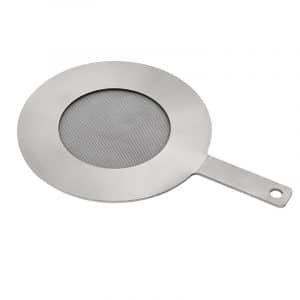
The plug-in screen (type S) serves the same purpose as the conical strainer but differs in its shape: it is built considerably flatter, which makes installation and removal substantially simpler and faster.
Key data:
- Nominal sizes from DN 15 to DN 350 (others on request)
- Material: stainless steel
- For installation between standard flanges to DIN EN 1092-1 form B1 / ANSI B16.5
- Shape, perforation and mesh size individually to customer requirements
The plug-in screen is particularly suitable wherever pipelines or plant components cannot be protected by a conical strainer for structural reasons, or only with considerable effort — for example in very confined installation situations. The flat design allows a quick change without having to dismantle larger sections of pipework.
Conical strainer or plug-in screen — which suits which situation?
| Criterion | Conical strainer | Plug-in screen |
| Shape | Conical (cone screen) | Flat |
| Filter area | Larger at the same nominal size | More compact |
| Installation/removal | Somewhat more involved | Very quick |
| Typical use | Start-up protection and continuous operation | Confined installation situations, frequent changes |
| Nominal size range | DN 20–600 | DN 15–350 |
In practice the choice is often a question of the available installation space: where there is enough room for the conical shape, the conical strainer offers the larger filter area. Where space is tight or a particularly quick change is required, the plug-in screen is the more pragmatic solution.
Flow direction: from the inside out or from the outside in
Besides shape and nominal size, the flow direction is a decisive design criterion for conical strainers and plug-in screens. Depending on the construction, the medium passes through the screen either from the inside out or from the outside in — the choice affects pressure loss, cleaning behaviour and the mechanical load on the screen.
Which flow direction is the right one?
The answer depends on several factors: the expected degree of contamination, the operating pressure, the accessibility required for maintenance and the installation situation within the pipeline. We take these criteria into account individually for each application — please talk to us directly about the right flow direction for your project.

Flow from the inside out
The medium first enters the interior of the screen and passes through the mesh or perforation from the inside outwards. Contaminants are deposited on the inside of the screen body and are immediately apparent during a visual inspection after removal. This design is often chosen where good accessibility for cleaning is the priority.

Flow from the outside in
In this variant the medium passes through the screen from the outside inwards — particles are deposited accordingly on the outside. This construction often offers greater mechanical stability against the flow pressure, because the screen body is supported from the outside, and is preferred at higher pressure ratings or with heavier particle loads.
Why start-up screens should be removed again after commissioning
An important practical note: start-up screens are not designed for permanent full-load operation. As contamination increases, the pressure loss across the screen rises — if operation continues, this can noticeably restrict the flow or, in extreme cases, damage the screen itself.
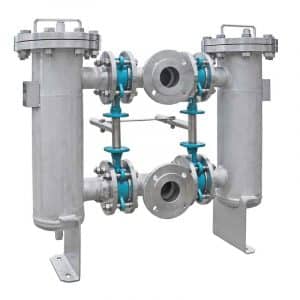
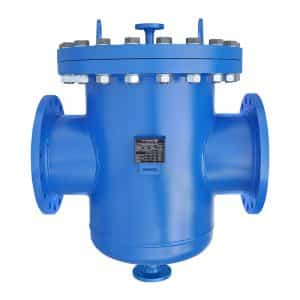
The rule of thumb is therefore: after the critical start-up phase the screen should be inspected, cleaned or removed. For applications that call for permanently higher loads, a filter type designed for continuous operation is the better choice — for example a simplex strainer or a basket strainer.


Can also be combined with a magnetic rod
As with the other filter types from Industriefabrik Schneider GmbH, conical strainers and plug-in screens can optionally be fitted with a magnetic rod, which additionally separates ferromagnetic particles such as iron or steel shavings — particularly relevant during the start-up phase, when welding and assembly residues frequently bring exactly this kind of contamination with them.
Also for other manufacturers’ equipment
Conical strainers and plug-in screens are manufactured not only as new parts for our own plants but also as replacement parts for existing systems from other manufacturers — made to fit exactly by nominal size, pressure rating and individual design. Operators who no longer wish to depend on the original supplier gain an independent source for replacements.
For smaller quantities and standard versions, plug-in screens, conical strainers and matching blank discs are also available directly from our online shop.


Conclusion
Conical strainers and plug-in screens are small components with a big effect: they protect the most expensive and most sensitive components of a plant at exactly the moment when the risk is greatest — the first commissioning. Industriefabrik Schneider GmbH manufactures both types of screen individually by nominal size, pressure rating and mesh size, for new plants as well as replacement parts for existing systems.
Products from the Pipe Fabrication / SKID Systems category

Make a request directly
Would you like individual advice?